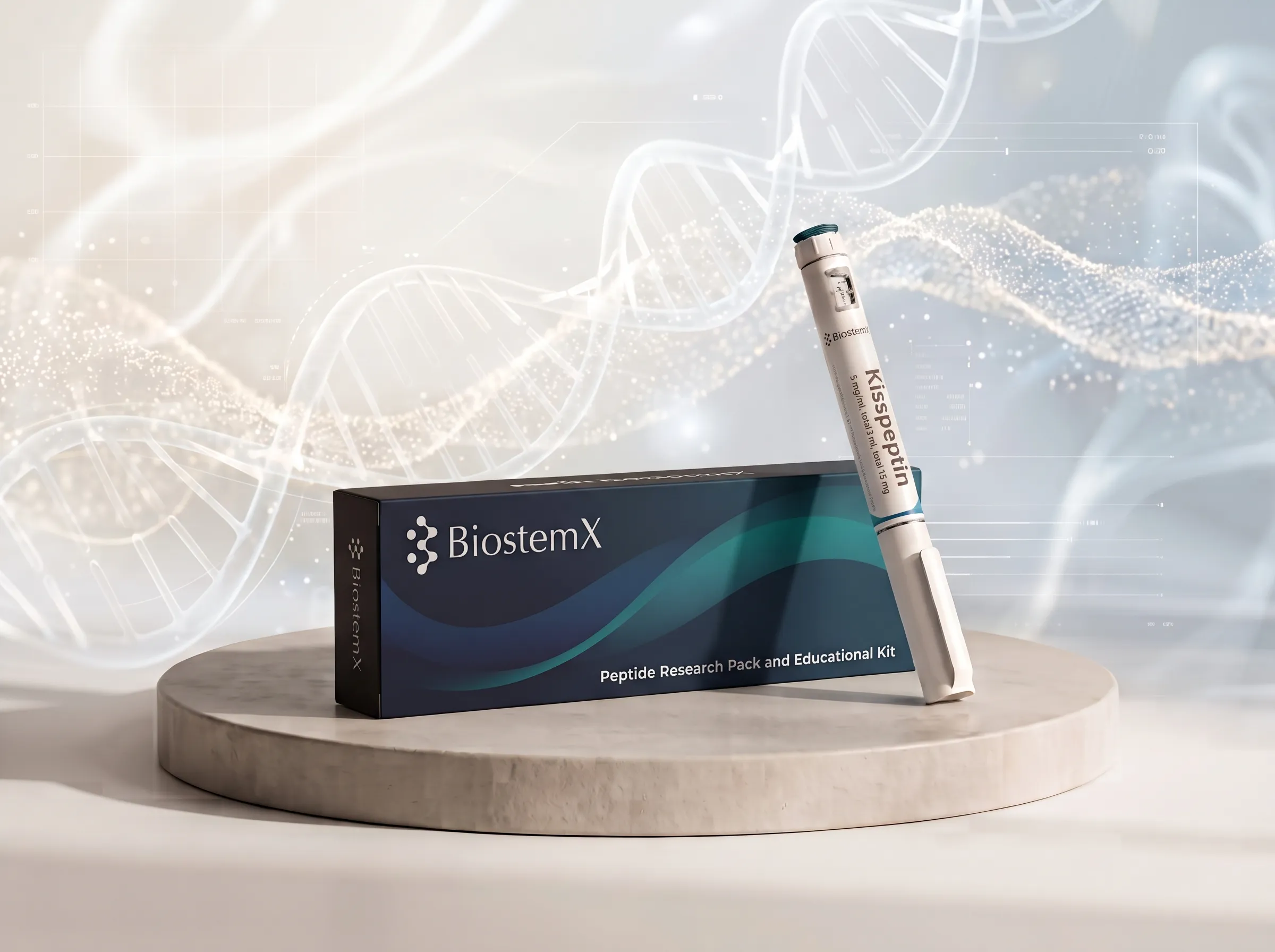
Kisspeptin

15mg

The “master switch” of the HPG axis, it physiologically stimulates pulsatile GnRH secretion
without suppressing the reproductive axis like exogenous testosterone. Indicated in postsuppression HPG axis restoration, hypogonadotropic hypogonadism, and functional
infertility. Its production is sensitive to the energetic, hormonal, and inflammatory state of
the body.

168 $

About

Kisspeptin is a family of peptides produced by the KISS1 gene, initially discovered in 1996
as a tumour metastasis suppressor, but is now known primarily for its central role in
reproductive endocrinology. Its key role in the regulation of reproductive and hormonal
function was identified in 2003, revolutionising the understanding of the hypothalamicpituitary-gonadal (HPG) axis.
The mechanism of action of Kisspeptin is based on binding to the specific KISS1R receptor
(also known as GPR54) in the KNDy neurons of the hypothalamus, where it triggers the
pulsatile secretion of GnRH (gonadotropin-releasing hormone). This signal reaches the
anterior pituitary gland stimulating the production of LH (luteinising hormone) and FSH
(follicle-stimulating hormone), which act at the gonadal level: in males they stimulate
testosterone secretion and spermatogenesis, in females they regulate ovulation and the
production of oestrogens and progesterone. Kisspeptin is therefore often described as the
“master switch” of the HPG axis, the neuroendocrine control centre that bridges the brain
and the reproductive system.
What makes Kisspeptin particularly interesting compared to other hormonal modulators is
its ability to stimulate the reproductive axis in a coordinated and physiological manner,
without suppressing it as occurs with exogenous testosterone or other anabolic steroids.
Its production is highly sensitive to the energetic, hormonal, and inflammatory state of the
body, making it a true metabolic and environmental sensor as well as a reproductive
regulator.

Administration and Dosage

Concentration: 5 mg/ml, total 3 ml, total 15 mg Frequency: daily Clicks per day: 10
Subcutaneous or intravenous administration, on specific medical indications. Frequency
and dosage must be personalised based on clinical condition and individual hormonal
response. Monitoring of LH, FSH, testosterone/oestradiol before, during, and after the cycle
is recommended to evaluate therapeutic response and adjust the protocol.

Clinical Trials and Results

Kisspeptin is the subject of active clinical research at numerous international centres, with
phase I/II studies documenting its efficacy and safety in various conditions of hormonal
and reproductive dysfunction.
Studies on hypogonadotropic hypogonadism have demonstrated that Kisspeptin
administration effectively restores pulsatile GnRH secretion and, in cascade, LH, FSH, and
testosterone levels in subjects with functional HPG axis deficit. These results are
particularly relevant in cases where the cause of hormonal deficit lies in hypothalamic
signalling rather than primary gonadal damage.
Research on female infertility has shown that Kisspeptin administration can induce
ovulation in women with functional hypothalamic amenorrhoea, a condition frequent in
athletes subjected to severe caloric restriction or training stress. Studies on the male side
have documented an improvement in sperm parameters and testosterone levels in
subjects with functional hypogonadism. Research on the interaction between Kisspeptin
and metabolic and inflammatory factors — including the pro-inflammatory cytokines IL-6
and TNF-α that suppress its production — has opened relevant clinical perspectives in
integrated hormonal optimisation protocols. If it receives official regulatory approvals in
the coming years, it could become the first physiological modulator of the reproductive
axis available in therapy.

Possible Side Effects

• Mild headache, generally transient and dose-related
• Mild nausea during the first administrations, self-limiting
• Transient sensation of warmth, related to the vasodilation produced by HPG axis
activation
• Possible mild hypersensitivity at the subcutaneous injection site
Kisspeptin’s safety profile is considered good in available clinical trials. Its nature as an
endogenous peptide and physiological mechanism of action contribute to a favourable
tolerability profile. Regular hormonal monitoring (LH, FSH, testosterone/oestradiol) is
essential for safe and effective treatment management.

Peptide Combinations

• PT-141: Synergy in sexual and hormonal health. PT-141 acts selectively on MC4R in
the hypothalamus increasing sexual desire centrally, while Kisspeptin stimulates
the HPG axis to restore endogenous testosterone and gonadotropin production. The
combination offers comprehensive support for male and female sexual and
hormonal health.
• Ipamorelin / CJC-1295 no DAC: Complete hormonal stack. GH secretagogues
stimulate pulsatile GH release, while Kisspeptin acts on the HPG axis. The
combination simultaneously supports the two main anabolic hormonal axes of the
body in a physiological and non-suppressive manner.
• Thymosin Alpha-1: Immuno-hormonal support. Thymosin Alpha-1 modulates the
immune response reducing pro-inflammatory cytokines such as IL-6 and TNF-α that
suppress Kisspeptin production, creating a more favourable immune environment
for HPG axis activity.
• BPC-157: Gastroprotective and systemic complementarity. BPC-157 reduces
systemic inflammation and protects gastrointestinal mucous membranes,
contributing to reducing levels of pro-inflammatory cytokines that can interfere with
kisspeptinergic signalling.
• Epitalon: Hormonal anti-aging stack. Epitalon acts on telomerase and
neuroendocrine regulation, while Kisspeptin maintains HPG axis activity. Together
they cover two distinct levels of neuroendocrine regulation in aging.

Benefits

• Natural and physiological stimulation of GnRH release: Activates KNDy neurons
in the hypothalamus to trigger pulsatile GnRH secretion in a manner that mimics the
body’s natural pattern, without significant receptor desensitisation in the short
term.
• Regulation of the reproductive axis without suppression: Unlike exogenous
testosterone and anabolic steroids, Kisspeptin stimulates the HPG axis without
suppressing it, preserving fertility and natural reproductive function.
• Increased libido and sexual function: Through stimulation of the HPG axis and
increase in endogenous testosterone and gonadotropin production, improves
sexual desire and reproductive function in both sexes.
• Support in post-suppression HPG axis restoration: Particularly indicated for the
restoration of hormonal function after cycles of suppression with exogenous
testosterone or anabolic steroids, where physiological axis stimulation is
compromised.
• Potential in functional infertility treatment: Clinical studies document its efficacy
in hypogonadotropic hypogonadism and functional infertility in both males and
females, where the problem lies in hypothalamic or pituitary signalling rather than
the gonads themselves.
• Support in athletes with RED-S syndrome: Kisspeptin production is suppressible
by caloric restriction, overtraining, and chronic stress. Its use is of particular interest
in athletes with Relative Energy Deficiency in Sport (RED-S) syndrome, where HPG
axis suppression produces amenorrhoea, testosterone decline, and bone health
compromise.
• No need for compensatory drugs: Unlike exogenous testosterone therapy, which
often requires aromatase inhibitors to avoid oestrogenic imbalances, Kisspeptin
stimulates the axis in a self-regulated manner, reducing the need for additional
compensatory drugs.
• Metabolic and environmental sensor: Integrates signals on the energetic,
hormonal, and inflammatory state of the body, making it a valuable biological
indicator of the overall health of the reproductive neuroendocrine axis.

Scroll to Top
✓ Item added to your cart!
View Cart Checkout